
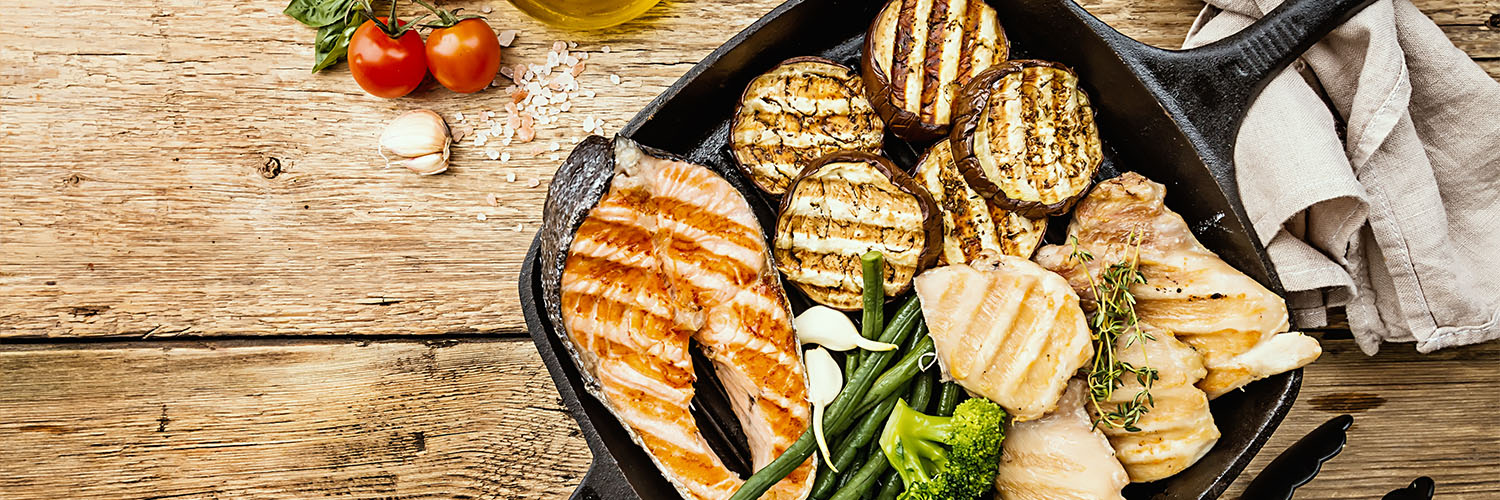
Choline and Brain Aging: Why This “Hidden Nutrient” Matters for Your Mind
As we age, our brains naturally lose some volume and function — memory can weaken, our brain’s processing speed slows and the risk of dementia increases. Emerging research suggests that Choline, a nutrient that is overlooked on the food label, plays a meaningful role in protecting the aging brain. We should all ask ourselves, “Am I consuming enough choline in my diet to meet my needs for optimal brain health?”
What Is Choline?
Choline is an essential vitamin-like nutrient, meaning your body needs it but doesn’t make enough on its own. This means we need to consume a sufficient amount of choline from the foods we eat to ensure our body has enough of it to function at its best. Choline plays several key roles in the body:
- Choline is used to make phosphatidylcholine, an important fatty acid in our body used as a major building block for cell membranes (especially in the brain).
- Choline is needed to make acetylcholine, a neurotransmitter important for memory, learning and muscle control.
- Choline helps with methylation, a chemical process that converts substances in our body into other forms allowing it to be utilized to maintain our health. Methylation is necessary for our metabolism to work properly and it also affects gene regulation and brain health.
Choline and Aging Brains: Current Findings in Brain Research
Higher Choline Intake Has Been Linked to Better Cognition
A long-term study following thousands of middle-aged and older adults found that people who ate more choline tended to have better cognitive scores and slower age-related decline in thinking skills over 6–21 years.
In practical terms, this means that dietary choline may help preserve memory and cognitive function as we get older.
Choline May Delay Cognitive Decline
Another large community study reported that older adults with higher choline intakes had lower odds of mild cognitive impairment (MCI) and performed better on memory and recall tests compared to those with lower choline intake.
This supports the idea that choline doesn’t just help brain cells function — it may even help delay certain aspects of brain aging.
Links to Alzheimer’s and Neurodegeneration
Some research shows that people with Alzheimer’s disease tend to have lower blood levels of choline and its related compounds, and this correlates with more severe brain pathology and inflammation. This doesn’t prove causation but does strongly suggest a connection between choline levels and brain aging processes.
Animal studies also support the idea that adequate choline supports healthy brain cell structure and signaling over time.
How Choline Supports the Brain
Here’s how choline may help protect an aging brain:
1. Neurotransmitter production:
Choline is needed to make acetylcholine, which is a critical neurotransmitter for memory and attention.
2. Cell membrane integrity:
Brain cells have membranes rich in phospholipids like phosphatidylcholine. Choline helps keep those membranes healthy.
3. Gene regulation:
Choline contributes to methylation reactions that affect gene expression, which may influence aging processes.
4. Brain nutrient transport:
Combined with other nutrients like DHA, choline may help the brain uptake and use essential fats for structure and function.
Foods High in Choline
Here are some great food sources that help you meet your choline needs (values approximate):
Rich Sources
- Beef liver (~356 mg/3 oz)
- Egg yolks (~147 mg per large egg)
- Chicken breast (~85 mg/4 oz)
- Salmon (~56–75 mg/3 oz)
- Black beans (~129 mg per cup)
- Broccoli (~30 mg per cup)
- Asparagus (~47 mg per cup)
- Soy products (tofu, soybeans) (~39–82 mg per serving)
Choline Requirements: Current recommendations are roughly 425 mg daily for women and 550 mg for men, though few people reach these levels without intentional dietary choices.
People at Higher Risk for Inadequate Choline Intake
Certain populations are at much higher risk of not getting enough of this important nutrient. Often, it is due to dietary restrictions that require avoidance of eggs and animal meats, higher requirements at certain stages of life, as well as gene variants that cause the body to produce less choline endogenously. Supplementation of choline is important for the following groups, especially if multiple risk factors are present. For example, a vegan menopausal woman following a low-fat diet or a breast-feeding woman who avoids eggs and has low animal protein intake.
Highest risk groups:
- Vegans due to the avoidance of eggs and animal meats
- People with diets high in ultra-processed foods that do not provide many nutrients
- Pregnant women have higher needs to support fetal brain development
- Postmenopausal women due to loss of estrogen
- People avoiding eggs
- Very low-fat or calorie-restricted dieters
- Older adults who eat less protein or have reduced appetite
- Individuals with certain genetic variants in genes associated with choline production or those who are ApoE4 carriers who have altered lipid metabolism.
Choline is an underappreciated nutrient that research links to better cognitive function and slower cognitive decline with age. While it won’t magically prevent dementia on its own, adequate intake — especially from whole foods — is a practical strategy for supporting brain health as we age. Consider a choline supplement if you do not consume the foods highest in choline that are listed above.
Choline Boost Power Bowl
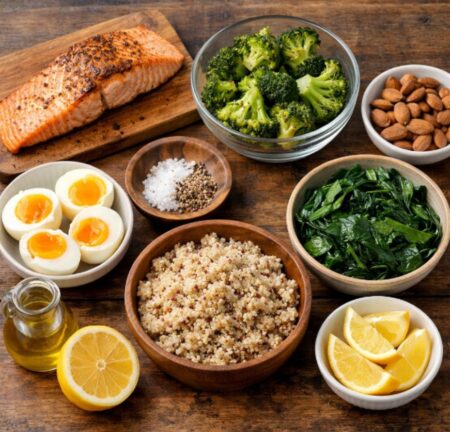
This nutrient-dense bowl can be prepared in larger batches by doubling the ingredients and providing multiple meals with less time spent in the kitchen. You can vary the vegetables in this dish based on your preferences or swap the quinoa for cauliflower rice if you are on a ketogenic diet.
Serves 2 | Total cook: ~25 min
Ingredients
- 4 large eggs (soft-boiled or poached)
- 1 cup cooked quinoa (25–30g carbs + protein)
- 1 cup roasted broccoli florets
- 1 cup sautéed spinach
- 4 oz salmon fillet (grilled)
- 2–3 tbsp toasted almonds
- 1 tbsp olive oil
- Lemon, sea salt, pepper to taste
Directions
- Cook quinoa per package.
- Season salmon with salt and pepper or as desired; grill or pan-sear until cooked to preference.
- Roast broccoli at 425°F (220°C) for 15–18 min with olive oil.
- Sauté spinach quickly in olive oil. Season with salt, pepper and/or some lemon juice if desired
- Assemble bowl: quinoa or cauliflower rice base, salmon, veggies and eggs.
- Top with almonds, lemon juice, salt & pepper. Dress with olive oil if your goal is to stay in ketosis.
Medicinal Aspects of This Recipe
- Eggs and salmon are high in choline as well as brain healthy omega-3 fats
- Quinoa and veggies provide antioxidants along with fiber for gut health
- Olive oil is a healthy fat that supports nutrient absorption and provides polyphenols which support gut health and reduce inflammation
References
- Zeisel, S. H., & da Costa, K. A. (2009). Choline: An essential nutrient for public health. Nutrition Reviews, 67(11), 615–623. https://doi.org/10.1111/j.1753-4887.2009.00246.x
- Wallace, T. C., Blusztajn, J. K., Caudill, M. A., Klatt, K. C., Zeisel, S. H., & Fenech, M. F. (2018). Choline: The underconsumed and underappreciated essential nutrient. Nutrients, 10(10), 1–19. https://doi.org/10.3390/nu10101391
- Poly, C., Massaro, J. M., Seshadri, S., Wolf, P. A., Cho, E., Krall, E., Jacques, P. F., & Rosenberg, I. H. (2011). The relation of dietary choline to cognitive performance and white-matter hyperintensity in the Framingham Offspring Cohort. The American Journal of Clinical Nutrition, 94(6), 1584–1591. https://doi.org/10.3945/ajcn.111.017277
- Nurk, E., Refsum, H., Drevon, C. A., Tell, G. S., Nygaard, H. A., Engedal, K., Smith, A. D., & Vollset, S. E. (2013). Intake of flavonoid-rich wine, tea, and chocolate by elderly men and women is associated with better cognitive test performance. (Note: Often cited in methylation/cognition discussions alongside choline research; included cautiously depending on framing.) The Journal of Nutrition, 139(1), 120–127. https://doi.org/10.3945/jn.108.095182
- Velazquez, R., Ferreira, E., Knowles, S., Fux, C., Rodin, A., Winslow, W., Oddo, S., & Ferreira, A. (2019). Lifelong choline supplementation ameliorates Alzheimer’s disease pathology and associated cognitive deficits by attenuating microglia activation. Aging Cell, 18(6), e13037. https://doi.org/10.1111/acel.13037
- Glade, M. J., & Smith, K. (2015). Phosphatidylcholine and brain function. Nutrition, 31(6), 711–717. https://doi.org/10.1016/j.nut.2014.12.004
- National Academies of Sciences, Engineering, and Medicine. (1998). Dietary reference intakes for thiamin, riboflavin, niacin, vitamin B6, folate, vitamin B12, pantothenic acid, biotin, and choline. National Academy Press. https://doi.org/10.17226/6015
- Caudill, M. A. (2010). Pre- and postnatal health: Evidence of increased choline needs. The Journal of the American Dietetic Association, 110(8), 1198–1206. https://doi.org/10.1016/j.jada.2010.05.009
- Zeisel, S. H. (2006). Choline: Critical role during fetal development and dietary requirements in adults. Annual Review of Nutrition, 26, 229–250. https://doi.org/10.1146/annurev.nutr.26.061505.111156
- Zeisel, S. H., & da Costa, K. A. (2009). Choline: An essential nutrient for public health. Nutrition Reviews, 67(11), 615–623. https://doi.org/10.1111/j.1753-4887.2009.00246.x
- Velazquez, R., Ferreira, E., Knowles, S., Fux, C., Rodin, A., Winslow, W., Oddo, S., & Ferreira, A. (2019). Lifelong choline supplementation ameliorates Alzheimer’s disease pathology and associated cognitive deficits by attenuating microglia activation. Aging Cell, 18(6), e13037. https://doi.org/10.1111/acel.13037
- Institute of Medicine. (1998). Dietary reference intakes for thiamin, riboflavin, niacin, vitamin B6, folate, vitamin B12, pantothenic acid, biotin, and choline. National Academy Press. https://doi.org/10.17226/6015
- Pawlak, R., Parrott, S. J., Raj, S., Cullum-Dugan, D., & Lucus, D. (2013). How prevalent is vitamin B12 deficiency among vegetarians? Nutrition Reviews, 71(2), 110–117. https://doi.org/10.1111/nure.12001