
TMS Therapy
Transcranial magnetic stimulation, guided by a brain map that is uniquely yours. A non-invasive, drug-free approach to memory, mood, and focus, built into your precision medicine plan.
What is TMS?
Transcranial magnetic stimulation, or TMS, is a non-invasive brain treatment that uses gentle magnetic pulses to stimulate specific areas of your brain. There are no needles, no anesthesia, and no surgery. A small coil is placed near your scalp and delivers precisely targeted pulses while you rest comfortably. You can drive yourself home immediately after your session and return to your normal activities right away.
How TMS works in the brain
TMS works by generating a brief magnetic field, similar in strength to an MRI, that passes harmlessly through the scalp and skull and produces a small electrical signal in the brain tissue below. Depending on the rhythm and pattern of those pulses, TMS can gently activate underactive brain circuits or calm overactive ones. Over a series of sessions, this is designed to support lasting changes in how brain networks communicate, a process known as neuroplasticity.
Why TMS is considered non-invasive
TMS requires no sedation and no recovery time. You are awake and alert throughout every session, and you leave able to drive, work, and carry on with your day. This sets it apart from treatments that require anesthesia or a period of downtime afterward. Ask if TMS is right for you →
Who might consider TMS?
TMS is FDA-cleared for major depressive disorder. Your Rezilir clinician may also recommend it, based on your evaluation and the evidence below, for several other uses that are considered off-label. Whether TMS is appropriate for you is a decision your clinician makes with you, based on your history, your QEEG, and your goals.
Mild cognitive impairment and early memory changes
TMS has been studied for its effect on memory, attention, and executive function in people with mild cognitive impairment and early Alzheimer’s disease, with improvements shown across multiple clinical trials. This is often one part of a broader plan alongside The Rezilir Way for Cognitive Decline.
Depression
TMS is FDA-cleared for major depressive disorder and is one of the most thoroughly studied non-drug treatments available. It is often considered when medication has not worked fully or has caused side effects.
Anxiety
Clinical research supports TMS for generalized anxiety disorder, with consistently positive results across the studies reviewed.
PTSD
TMS targeting the prefrontal cortex has been shown to produce meaningful symptom relief in post-traumatic stress disorder.
Attention difficulties
Emerging research shows TMS can meaningfully reduce inattention and hyperactivity symptoms in adults.
OCD and food cravings
Emerging evidence suggests TMS may help reduce symptoms of OCD and food cravings in adults.
When more than one of these overlap
Many patients are navigating more than one of these at once. TMS addresses them through the same brain region, the dorsolateral prefrontal cortex, using the same device and the same treatment course.
Ask if TMS is right for you →
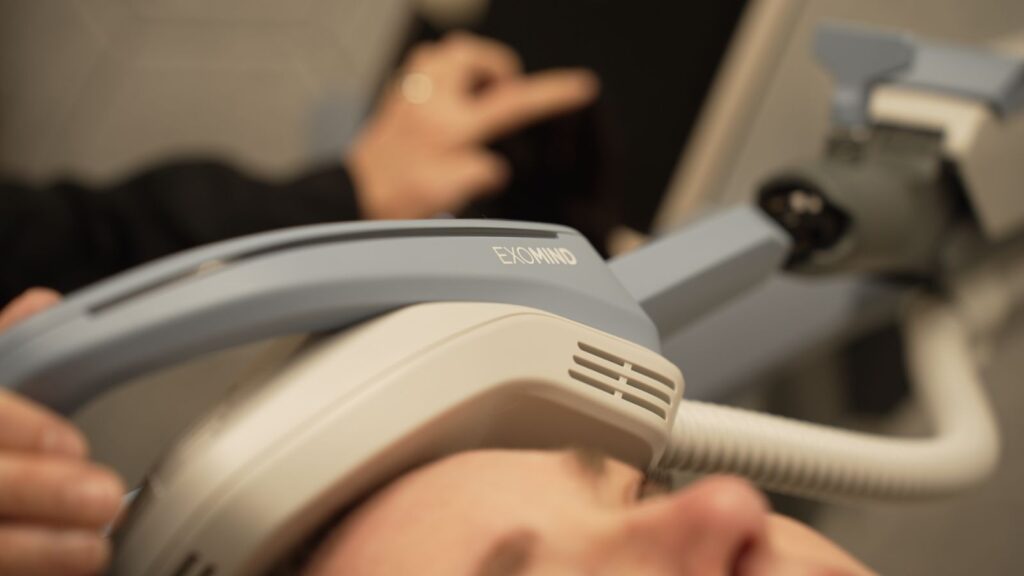
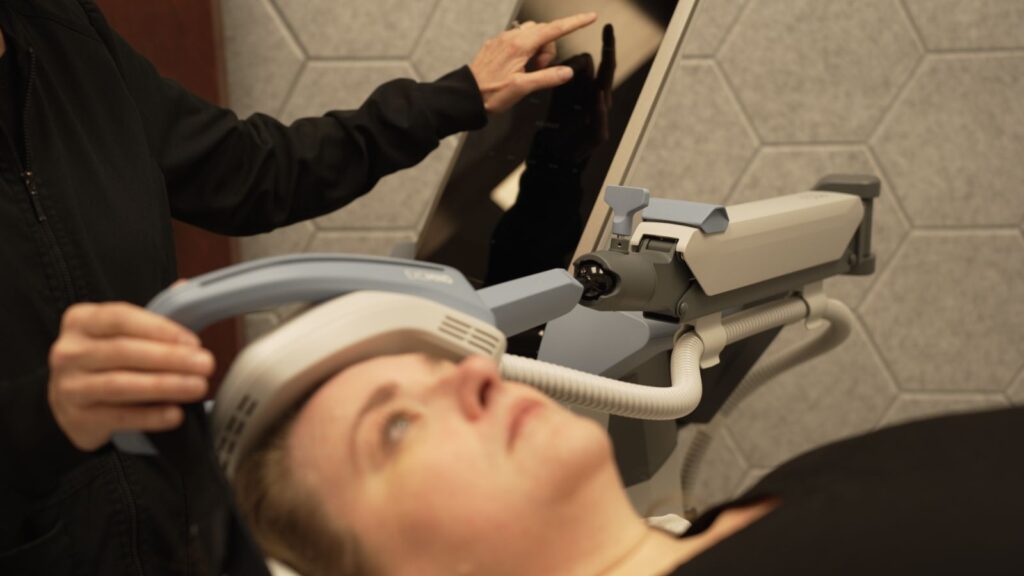
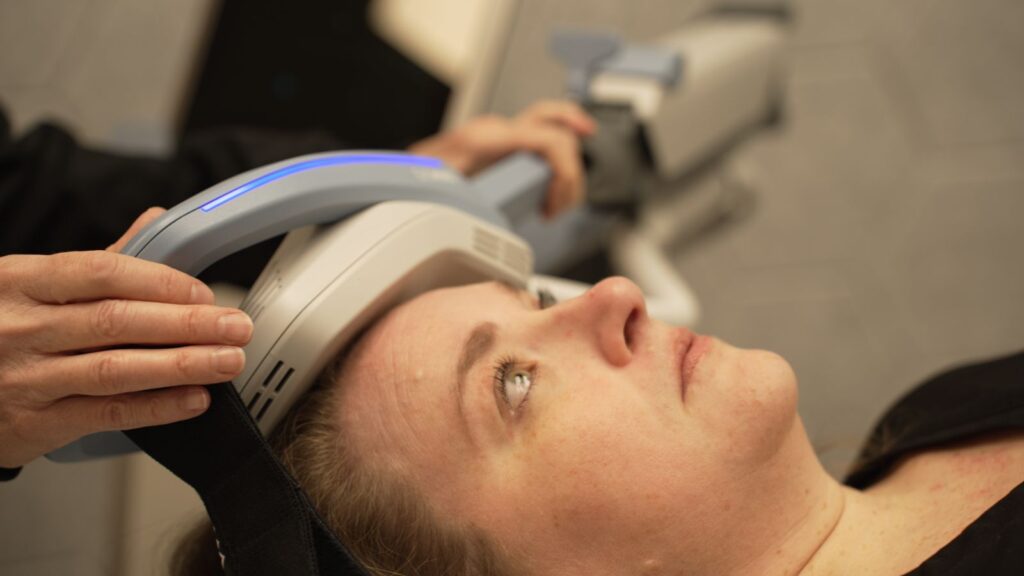
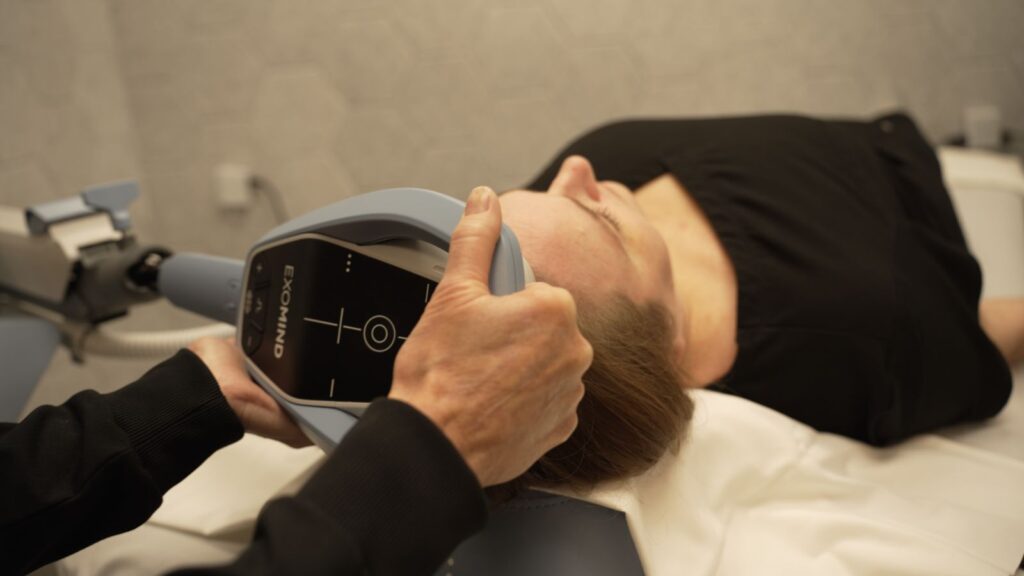
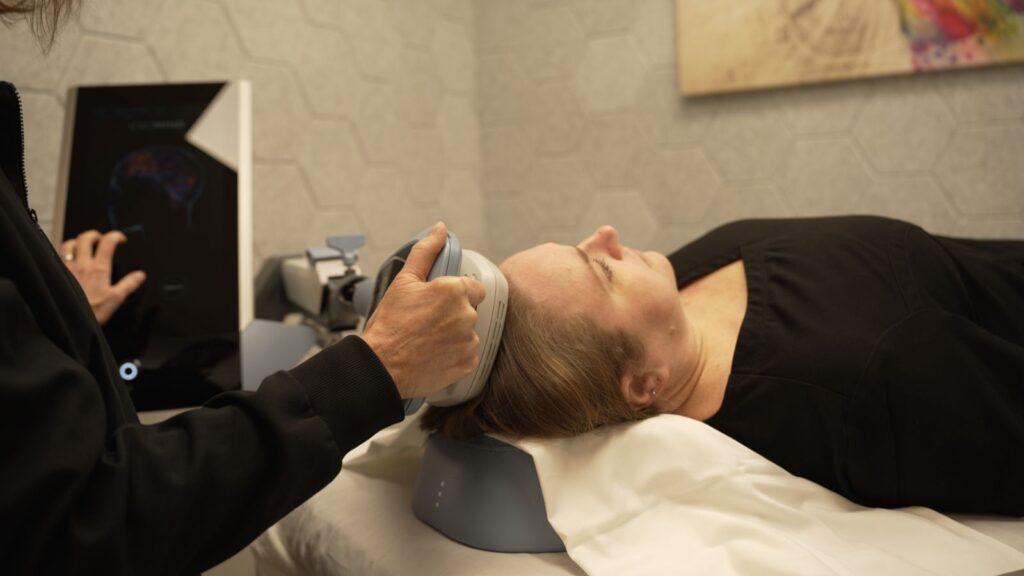
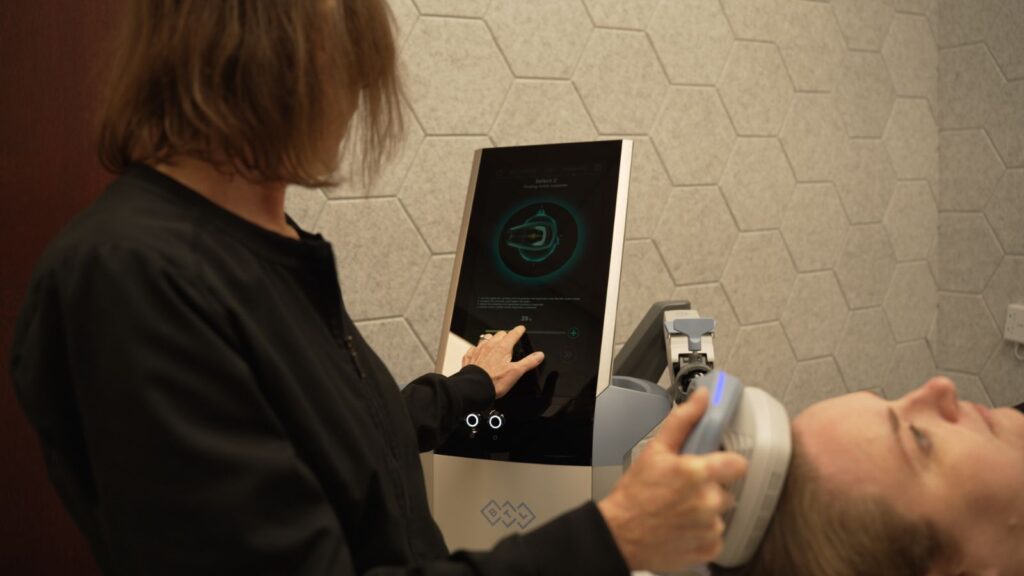
The device we use: ExoMind by BTL
Rezilir Health uses the ExoMind device by BTL Industries, an FDA-cleared TMS platform built for comfort and precision. ExoMind uses BTL’s ExoTMS technology to deliver gentler, precisely shaped pulses, and AI-assisted guidance helps ensure the coil is positioned accurately over the correct brain region at every session. According to BTL’s own published clinical data, the large majority of patients in its trials reported comfort throughout treatment.
Your brain map: how QEEG guides your treatment
Before treatment begins, Rezilir Health performs a detailed set of questionnaires on your brain’s function along with a quantitative EEG, or QEEG, a “brain map” that records your brain’s electrical activity and compares it to a large database of healthy individuals your age. This is completely painless. You wear a cap with small sensors on your scalp for about 15 to 20 minutes.
What your QEEG shows
Your QEEG tells your clinician which brain circuits are underactive, most commonly the left prefrontal cortex in people with cognitive decline, depression, or anxiety. It also shows which networks are disrupted, whether that is the memory network, the attention network, or the mood regulation network, and whether treatment is engaging the correct circuits. Your QEEG can be rechecked after your first few sessions to confirm this.
The follow-up QEEG
After your full treatment course, a follow-up QEEG gives you and your clinician an objective measurement of whether your brain networks have normalized, tangible evidence of how your treatment is working.
What to expect, session by session
Before your first session
Your physician will have reviewed your MRI, cognitive test results, and medical history. At your first visit, a brief calibration procedure called motor threshold determination finds the precise stimulation intensity that is right for your brain, so your treatment is personalized from the start.
During a session
Each session lasts approximately 30 minutes. You lie down comfortably while the TMS coil is positioned on your scalp and held in place. You will hear a rhythmic clicking sound (earplugs are provided but usually not needed) and feel a tapping or knocking sensation on your scalp. Some patients notice mild facial muscle twitching during the first few sessions. This is normal and settles quickly as your coil position is fine-tuned.
After a session
No recovery time is needed. You can drive, work, exercise, and carry on with your day immediately.
How many sessions will I need?
| Protocol | Sessions | Typical use |
|---|---|---|
| Protocol I | 6 to 10+ sessions | Mood-dominant courses: depression, anxiety, PTSD |
| Protocol II | 10 to 20+ sessions | Cognitive and mixed cases: MCI, early Alzheimer's, mixed presentations |
Most patients treated for cognitive improvement complete Protocol II for full benefit.
Protocol I: the mood-dominant course
For depression, anxiety, and PTSD.
Protocol II: the primary cognitive course
For MCI, early Alzheimer’s disease, and mixed presentations.
When will I notice a difference?
Everyone’s response is individual, and because Protocol I and Protocol II serve different goals, their timelines differ too.
Mood response timeline
| Timeframe | What many patients report |
|---|---|
| Sessions 1 to 3 | Mild scalp sensitivity, no mood change yet |
| Sessions 4 to 6 | Early mood lift in some patients: reduced emotional heaviness, improved sleep quality |
| Sessions 7 to 10+ | Sustained mood improvement, reduced anxiety, better emotional regulation |
| After completing Protocol I | Mood gains typically persist several weeks to months; maintenance sessions can sustain long-term benefit |
Cognitive response timeline
| Timeframe | What many patients report |
|---|---|
| Sessions 1 to 5 | No noticeable cognitive change yet; brain adapting; scalp sensitivity most common in this phase |
| Sessions 6 to 15 | Reduced brain fog, easier word retrieval, clearer thinking, often before test scores change |
| Sessions 16 to 20+ | Measurable improvements in working memory, attention, and executive function for most responders |
| After completing Protocol II | Cognitive gains persist for one to three months after finishing, with measurable QEEG normalization |
What does the research show?
Transcranial magnetic stimulation has been studied for decades, with a substantial and growing body of evidence behind it.
Memory and cognition
A 2025 meta-analysis of 31 randomized controlled trials found that rTMS produced significant improvements in immediate cognition, with gains maintained one to three months after treatment ended. A larger analysis of 143 studies encompassing 5,800 participants confirmed significant improvements across global cognition, episodic memory, executive function, and language in patients with MCI and Alzheimer’s disease. Combining TMS with cognitive tasks, something we incorporate into your treatment plan, produces additional benefits beyond TMS alone.
Depression
TMS is FDA-cleared for major depressive disorder and is one of the most thoroughly studied non-drug treatments available. Roughly half to three-fifths of patients with treatment-resistant depression respond to TMS, and about a third achieve full remission. An accelerated protocol developed at Stanford has demonstrated high remission rates in an open-label study.
Anxiety
A meta-analysis of six randomized controlled trials found TMS produced a large effect for generalized anxiety, with every included study showing a positive result.
PTSD
Across 19 studies, TMS produced a large effect size for PTSD symptom reduction. A 2026 study of navigated TMS combined with therapy found 85 percent of participants showed significant relief at one month, with most maintaining gains at three months.
Attention and ADHD
A 2025 systematic review and meta-analysis found TMS produced large, significant reductions in inattention and hyperactivity in adults with ADHD, with gains persisting at one-month follow-up.
Is TMS safe?
TMS has a strong safety record across decades of clinical use. It does not affect your liver, kidneys, heart, or digestive system, and it does not interact with your medications. Unlike some other brain treatments, TMS carries no risk of memory loss, sedation, or confusion.
Common and temporary side effects
The most common side effects are scalp discomfort or a mild headache at the stimulation site, along with occasional facial twitching in early sessions. These typically resolve within 30 to 60 minutes and diminish after the first week.
Seizure risk
Seizure risk with TMS is very rare, at approximately 7 per 100,000 sessions.
Who should not receive TMS
Your safety is reviewed before your first session, not partway through it. TMS is not appropriate if you have ferromagnetic metal implants near your head, such as certain cochlear implants, aneurysm clips, or other metal plates, a pacemaker or implanted cardiac device near the coil, or active uncontrolled epilepsy. Your clinician reviews all of this with you at your screening visit, so it is settled before you begin.
How TMS fits into your precision medicine plan
TMS is never a standalone treatment. It is one layer in a comprehensive, personalized brain health strategy, designed to work best alongside the Essentials and your broader care plan:
- Structured cognitive activity during and after your treatment course
- Aerobic exercise, which supports the release of BDNF, a key protein for brain plasticity
- Sleep optimization, since memory consolidation from TMS happens primarily during deep sleep
- Targeted nutritional support, as recommended by your clinician
- Ongoing biomarker monitoring through your QEEG, cognitive tests, and blood work, giving a longitudinal picture of your brain’s trajectory
Your treatment team
Your TMS treatment at Rezilir Health is directed by your physician and supported by our clinical team, who will:
- Review your QEEG before treatment begins and after your course concludes
- Calibrate your individual treatment intensity at your first session
- Monitor your response at every visit and adjust as needed
- Coordinate your TMS with your broader Rezilir Health care plan
Ready to find out whether TMS is right for you?
TMS at Rezilir Health starts with a conversation, not a commitment. Your clinician will review your history and your QEEG to help you understand whether TMS fits your precision medicine plan.
Frequently asked questions
Will I be awake during treatment?
Yes. You are fully awake, alert, and able to have a conversation throughout. White noise, relaxing sounds, or music can be available during your session, and some patients feel relaxed enough to rest.
Does it hurt?
Most patients describe the sensation as a tapping or knocking on the scalp, unfamiliar but not painful.
How long before I see results?
Subjective changes often begin within a few weeks, with measurable improvements typically emerging as your treatment course continues. Full benefit accumulates over the complete course.
What if I miss a session?
Contact our office as soon as possible to reschedule. Maintaining a regular session schedule produces the best outcomes, and an occasional missed session is manageable.
What if TMS doesn't work for me?
Response varies from person to person, which is exactly why your course includes a QEEG before you start and another when it’s complete: real measurement, not just an impression. If your results aren’t where you and your clinician expect, that becomes new information for your care team to act on, not a dead end. TMS is one layer of your broader precision medicine plan, and your plan can be adjusted as you go.
Will I need maintenance treatments?
Your follow-up QEEG guides the decision about maintenance sessions, typically monthly or biweekly, to help sustain your gains long-term.
References
- Li H et al. (2025). The effect of rTMS on immediate and long-term cognitive functions in Alzheimer’s disease and MCI: a meta-analysis.
- Nguyen TD et al. (2024). Efficacy and safety of TMS on cognition across diagnoses: systematic review and meta-analysis of 143 studies. International Psychogeriatrics.
- Chen R, Fitzgerald PB, Blumberger DM. A Practical Guide to TMS Neurophysiology and Treatment Studies. Cambridge University Press, 2022.
- Rabey JM et al. (2013). rTMS combined with cognitive training in Alzheimer’s disease. Journal of Neural Transmission, 120(5), 813-819.
- Cirillo P et al. (2022). Efficacy of neurostimulation across mental disorders: meta-analysis. Nature Molecular Psychiatry.
- BTL Industries (2025). ExoMind Clinical Evidence Overview.
- Cole EJ et al. Stanford SAINT trial results.
- Sathappan AV et al. (2022). rTMS for GAD: systematic review and meta-analysis. International Journal of Neuropsychopharmacology, 25(2).
- Cosmo C et al. (2021). TMS as treatment for PTSD: meta-analysis.
- Fox SD et al. (2026). MRI-guided navigated TMS for PTSD + psychotherapy. JAMA Network Open.
- Huang Z et al. (2025). Efficacy and safety of TMS for ADHD: systematic review and meta-analysis. PMC.
Disclaimer: This website is provided for informational purposes only and does not constitute endorsement of treatments, individuals, or programs which appear herein. Any external links on the website are provided for the visitor’s convenience; once you click on any of these links you are leaving the Rezilir Health® website. Rezilir Health® has no control over and is not responsible for the nature, content, and availability of those sites.