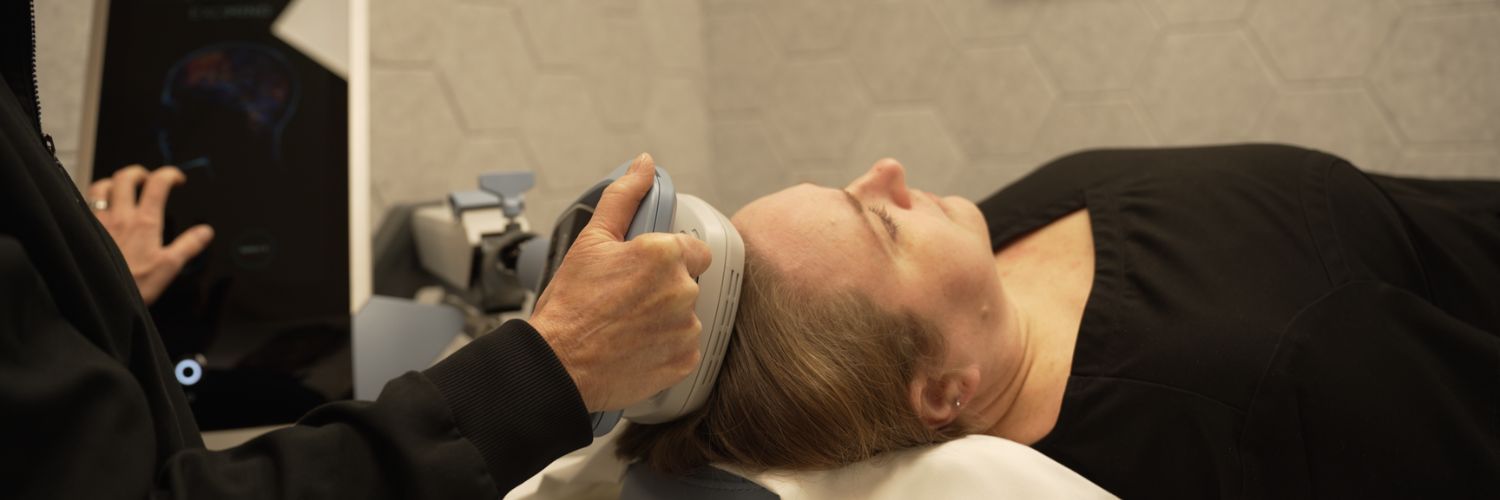
A brief magnetic pulse, delivered through the scalp, generates a small electrical current in the brain tissue underneath. Depending on the rhythm and pattern of those pulses, that current can wake up underactive circuits or quiet overactive ones. The pulse is strong enough to change how neurons fire. It is gentle enough that you drive yourself home afterward.
This is transcranial magnetic stimulation. It has been around in research labs since the mid-1980s and in the medical literature for more than 17,000 publications. What changed in the last two years, and what made us bring TMS into Rezilir Health as a core offering, is the precision of the targeting, the comfort of the newer devices, and the depth of the evidence across the conditions our patients actually walk in with.
This piece is about why we added TMS, how we use it inside a precision-medicine plan, what the trials actually show, and where we are still being careful.
Why we added TMS now
For the last ten years, Rezilir Health has practiced precision medicine for cognitive decline built around the principles articulated in Dr. Dale Bredesen’s ReCODE framework. We test root causes. We treat the upstream drivers: infection, toxicants, metabolic dysfunction, sleep, vascular health. We track response with biomarkers most clinics never order.
That approach works. As co-principal investigators in implementing the Evanthea trial, a randomized controlled trial of precision medicine for mild cognitive impairment and early Alzheimer’s, we have seen what a well-built precision-medicine protocol can do on its own.
But there is a limit to what biochemistry alone can do once a brain network has been quiet for years. Circuits need to fire to rebuild themselves. That is the basic rule of neuroplasticity: neurons that fire together, wire together. If a circuit has been underactive long enough, kickstarting it with metabolic support and lifestyle change is sometimes not enough. You need to drive the circuit directly.
That is what neuromodulation does. And it is what TMS does most precisely.
We recently completed a paper analyzing the Evanthea participants who received an integrated package of neuromodulatory therapies plus hyperbaric oxygen therapy at 2.0 atmospheres layered on top of the precision-medicine protocol, compared with participants who received precision medicine alone. The findings were very positive.
We saw large additional gains on memory and executive function in the group that received neuromodulation, with the divergence concentrated in the months when neuromodulation was actually being delivered. This is post-hoc, exploratory work, and we are not putting specific numbers on it until peer review is finished. But the signal was strong enough that adding neuromodulation to our standard practice was no longer optional. TMS is the most precise, best-evidenced circuit-level tool now available, and it is the natural next layer.
What TMS actually does inside the brain
The coil sits near your scalp. It generates a brief magnetic field, similar in strength to an MRI, that passes harmlessly through skin and skull. That field induces a small electrical current in the brain tissue a few centimeters underneath. Depending on the frequency of the pulses, that current either increases the excitability of the local circuit (high-frequency stimulation) or decreases it (low-frequency stimulation).
The target we use most often is a region called the dorsolateral prefrontal cortex, or DLPFC. The DLPFC sits behind your forehead, on the left and right sides. It is one of the most consistently underactive regions in people with cognitive decline, depression, anxiety, PTSD, and adult ADHD. The same region, the same device, the same general approach, addressing what is, in many of our patients, the same underlying problem of an under-firing prefrontal network.
Over a series of sessions, repeated stimulation produces lasting changes in how that network communicates with the rest of the brain. That process is called long-term potentiation, and it is the cellular basis of how the brain learns anything. TMS uses your brain’s own learning machinery to rewire a quiet network.
This is not subtle pharmacology. It is electricity, applied with intent, to a specific circuit.
Why QEEG-guided targeting matters
Most TMS clinics aim the coil by anatomy: measure the scalp, find the standard location, place the coil. That works. It is also a one-size-fits-all approach to an organ that is, famously, not one-size-fits-all.
In our clinic, every patient who is a candidate for TMS gets a quantitative EEG (a QEEG) before treatment begins. The QEEG is a brain map. You wear a cap with small sensors for fifteen to twenty minutes. The recording compares your brain’s electrical activity to a large database of healthy individuals your age, and it tells us three things that matter for treatment.
First, which of your brain’s networks are underactive. Most commonly this is the left prefrontal cortex in people with cognitive complaints, depression, or anxiety. Second, which networks are disrupted: the memory network, the attention network, the mood regulation network. Third, whether the treatment is actually engaging the circuit we are trying to reach. We can recheck the QEEG after the first few sessions to confirm we are on target.
When the treatment course finishes, a follow-up QEEG gives you and your physician an objective measurement of whether the network changed. Not just whether you feel better — though that matters — but a measurable shift in how your brain is firing. Patients who improve subjectively almost always show network changes on the QEEG. The two track together.
This is the precision-medicine version of TMS. Most clinics treat the diagnosis. We treat the circuit.
What the trials actually show
The evidence base for TMS is one of the largest for any non-drug brain treatment. A few specific findings are worth knowing.
For memory and cognition. A 2025 meta-analysis of 31 randomized controlled trials found that repetitive TMS produced significant improvements in immediate cognition, with a standardized mean difference of 0.93 (a large effect size), and those gains were still measurable one to three months after treatment ended (Li et al., Journal of Psychiatric Research, 2025). A larger analysis of 143 studies and 5,800 participants confirmed significant improvements in global cognition, episodic memory, executive function, and language in patients with mild cognitive impairment and Alzheimer’s disease (Nguyen et al., International Psychogeriatrics, 2024). Combining TMS with cognitive tasks, which we build into the protocol, adds further benefit on top of TMS alone (Rabey et al., Journal of Neural Transmission, 2013).
For depression. TMS has been FDA-cleared for major depressive disorder since 2008 and is one of the most thoroughly studied non-drug treatments in psychiatry. Roughly 50–60% of patients with treatment-resistant depression respond, and 30–35% reach full remission (Cirillo et al., Molecular Psychiatry, 2022). The Stanford SAINT protocol — an accelerated, intensive version — pushed remission rates to 79% in an open-label study (NCT07043738).
For anxiety. A meta-analysis of six randomized controlled trials in generalized anxiety disorder found an effect size of SMD = −1.86, with every included study showing benefit (Sathappan et al., International Journal of Neuropsychopharmacology, 2022). For context, that effect size is larger than what most anxiety medications produce.
For PTSD. Across 19 studies, TMS produced a large effect on symptom reduction (Cohen’s d = 1.17) (Cosmo et al., Journal of Anxiety Disorders, 2021). A 2026 trial of MRI-guided navigated TMS combined with psychotherapy found 85% of participants showed significant relief at one month, with 73% still benefiting at three months (Fox et al., JAMA Network Open, 2026).
For adult ADHD. A 2025 systematic review and meta-analysis found TMS produced large reductions in inattention (SMD = −0.94) and hyperactivity/impulsivity (SMD = −0.98), with gains persisting at one-month follow-up (Huang et al., 2025).
A pattern emerges. The same brain region, the same device, the same treatment course, applied to what looks like a different list of diagnoses, and the effect sizes are consistently in the range that clinical research treats as meaningful. The most likely explanation is that prefrontal hypoactivity is a shared upstream feature of these conditions, and that re-engaging the circuit produces benefit across the diagnostic labels we put on top of it. That is a precision-medicine reading of the evidence, and it is consistent with what we see when we treat patients in our clinic.
What changed: comfort and speed
If you talked to someone who got TMS ten years ago, they probably described it as tolerable but unpleasant: the pulse pattern was sharper, the coil ran hotter, and the sessions ran longer.
The newer-generation devices are different. We use the ExoMind device by BTL Industries, an FDA-cleared platform built specifically around comfort and precision. ExoMind uses patented pulse-shaping technology that delivers gentler, more precisely contoured magnetic pulses than older TMS systems. In 2024–2025 clinical trials of more than 200 participants, 95% of patients reported the treatment as comfortable throughout the course (BTL clinical evidence overview). The device also uses AI-assisted guidance to verify coil position at every session, which used to be a manual job and a meaningful source of variability.
Speed has also changed. The accelerated protocols pioneered at Stanford, the SAINT protocol, compressed a multi-week depression treatment into days, with remission rates that surprised the field (Cole et al.). The ExoMind protocol uses a similar accelerated session format for mood-dominant courses. Most patients we treat for depression, anxiety, or PTSD notice meaningful change earlier than they expect.
Both of these things matter enormously for whether patients finish the course. A treatment that works only if you complete 30 sessions, but is unpleasant enough that people stop at session 8, is not actually a treatment.
What a course looks like, from your side of the chair
You arrive. Your physician has already reviewed your cognitive testing, your QEEG, and your medical history. The first visit includes a brief calibration step called motor threshold determination, which finds the precise stimulation intensity that is right for your specific brain. We do this once, and we use the result to personalize every subsequent session.
Each session runs about thirty minutes. You lie down on a comfortable table, and the coil is positioned and held in place. You hear a rhythmic clicking and feel a tapping sensation on your scalp. Some patients notice mild facial muscle twitching in the first few sessions; this settles quickly once the coil position is fine-tuned. You can drive, work, and exercise immediately afterward.
We use two protocol lengths depending on what we are treating.
For mood-dominant courses (depression, anxiety, PTSD), we typically run a shorter, accelerated course of six to ten or more sessions. Many patients notice meaningful mood shifts within the first week or two. Sustained improvement usually emerges by the end of the course. Gains often persist for several months, with occasional maintenance sessions to keep them.
For cognitive courses (mild cognitive impairment, early Alzheimer’s, mixed presentations), we typically run a longer course of ten to twenty or more sessions, scheduled three to five days a week. Cognitive circuits respond more gradually than mood circuits. This is expected. Patients and their families often notice behavioral changes such as less apathy, more engagement in conversation, and better word retrieval before formal cognitive test scores move. Measurable improvements on working memory, attention, and executive function tests usually begin around sessions 16–20, with the QEEG showing measurable network normalization at the end of the course. Cognitive gains typically persist one to three months after a full course; when TMS is part of a complete precision-medicine plan that addresses the root causes, the benefits tend to last longer.
We monitor response at every session and adjust as needed. If something is not working, we will tell you.
The Safety Picture
TMS has an excellent safety record across decades of clinical use and millions of treatment sessions.
It does not affect your liver, kidneys, heart, or digestive system. It does not interact with your medications. There is no sedation, no memory loss, and no recovery period. This is one of TMS’s most important advantages over other brain treatments that work by very different mechanisms.
The most common side effects are mild and temporary. Scalp discomfort or a mild headache at the stimulation site occurs in roughly 10–25% of patients, and occasional facial twitching shows up in early sessions. These usually resolve within thirty to sixty minutes and diminish over the first week as the coil position is fine-tuned. The newer pulse-shaping technology on the ExoMind device meaningfully reduces these sensations compared with older systems.
Seizure risk with TMS is very rare, approximately 7 per 100,000 sessions, which is lower than the seizure risk of many antidepressant medications. TMS is not appropriate for people with ferromagnetic metal implants near the head, certain pacemakers or implanted cardiac devices near the coil, or active uncontrolled epilepsy. Your clinician will screen for all of this before treatment is offered.
Where TMS fits inside a precision-medicine plan
TMS is not a standalone treatment in our clinic. It is one layer in a comprehensive brain health strategy.
The mechanism makes the integration obvious. Neuroplasticity is metabolically expensive. Rewiring a circuit requires functional mitochondria, intact cell membranes, adequate methylation capacity, controlled neuroinflammation, and sleep deep enough to consolidate the changes. If any of those upstream systems are broken, TMS will work less well — sometimes much less well — than it could.
So we run the workup first. We test for the things we always test for at Rezilir: metabolic markers and HOMA-IR, mitochondrial markers on the NutrEval, atrophy patterns on the NeuroQuant volumetrics, hormone panels, chronic infection and toxicant exposures, sleep architecture. We address what needs addressing. Then we add TMS into a brain that is metabolically prepared to use it.
In parallel with the TMS course, we ask patients to:
- Engage the circuits being stimulated. Structured cognitive activity during and after the treatment course amplifies plasticity. The trials that combined TMS with cognitive tasks consistently outperform TMS alone (Rabey et al.).
- Move aerobically. Exercise raises BDNF, the growth factor that supports the synaptic changes TMS initiates.
- Sleep. Memory consolidation from TMS happens primarily during deep sleep.
- Maintain the metabolic groundwork. Targeted nutrition, the supplements we have identified for your case, and the lifestyle changes we have already discussed.
This is what we mean when we talk about precision medicine for the brain. TMS is a powerful tool. It works best when the rest of the system is set up to receive it.
Where the evidence is emerging
The trials that exist are large and convincing in the short and medium term. The follow-up windows do not yet tell us what happens at five years or ten. We are watching the literature carefully and tracking our own patients with serial QEEG and cognitive testing to build that picture.
Combination treatment, where TMS is layered onto a full precision-medicine protocol, has not been formally trialed. The component evidence for TMS is strong. The Evanthea neuromodulation analysis points in a clear direction: adding circuit-level neuromodulation on top of precision medicine produced larger gains than precision medicine alone. But that analysis used an integrated package of neuromodulatory tools, was post-hoc and exploratory, and was not a randomized test of TMS specifically. The formal RCT of “TMS plus full precision-medicine protocol versus precision medicine alone” has not been run. We are not going to pretend otherwise.
And TMS is not for everyone. Some patients respond strongly, some respond modestly, and a smaller group does not respond, and we want to know that early, which is part of why the QEEG re-check matters. If a patient’s brain is not responding to the stimulation, we want to find that out at session 4, not session 20.
How to find out if TMS makes sense for you
TMS is now part of the standard brain-health toolkit at Rezilir Health. If you are working with us, your physician will raise TMS as an option when the clinical picture supports it — cognitive complaints, depression, anxiety, PTSD, ADHD, or some combination of these.
If you are not yet a Rezilir patient and want to know whether TMS makes sense for you, the first step is a brain-health consult. We will review your history, your prior testing, and what you have already tried. If TMS looks like a reasonable next layer, we will say so. If it does not, we will say that too, and tell you what we would do instead.
Book a brain-health consult to discuss TMS.
A note on cost and access: TMS is FDA-cleared for major depressive disorder and OCD, and insurance frequently covers it for those indications when first-line treatments have not worked. For cognitive decline, anxiety, PTSD, ADHD, and other off-label uses, TMS is currently a cash-pay treatment in our clinic.
This piece is educational, not medical advice. Whether TMS makes sense for you depends on your individual history, your current medications, and your specific clinical picture. That conversation belongs with your own clinician.